How to become a social media manager with no experience
Most guides tell you to take a course and apply for jobs. There’s a faster route: go freelance, make your own proof, and let local businesses hire you.
You can become a social media manager with no experience by going freelance instead of job hunting. Learn the basics in a week, make your own proof (sample posts, your own account, one discounted client), pick a niche, then message local businesses that need help. You don’t need a degree, a certificate or a big following.
Job vs freelance: two routes into social media management
| Get hired (job route) | Go freelance | |
|---|---|---|
| Who decides | A recruiter comparing you to people with experience | A business owner who just wants more customers |
| What you need first | Degree or course, portfolio, interviews | A few sample posts and the nerve to send messages |
| Time to first pay | Often months of applying | Often weeks, if you do outreach daily |
| Income | A fixed salary | Monthly retainers per client. You set the price |
| Best for | People who want a team and a boss | People who want to work from home on their own terms |
Both are valid. This page is about the freelance route, because it’s the one where “no experience” matters least. Owners don’t ask for your CV. They ask, “Can you bring me customers?”
The skills you actually need (and can learn in a week)
- Writing short captions and hooks that sound like a person, not an ad.
- Making simple posts and short videos in Canva and CapCut, or your phone’s editor.
- Planning a month of content in a simple calendar.
- Reading basic numbers: reach, profile visits, link clicks, messages.
- Talking to owners: short messages, a 15-minute call, a clear offer.
Notice what’s missing: degrees, certifications, design school and a big personal following. AI tools like Claude can help you draft captions, plan calendars and check profiles, as long as you review everything yourself.
3 ways to get proof without any clients
Spec posts for a real business
Pick a real business in your niche and design the 9 posts you’d make for them. Label them “concept work,” never as a paid project. This shows you understand their customers.
Your own account as a live demo
Run your own page for 30 days the way you’d run a client’s: a clear bio, 3 posts a week, a few short videos. It shows you can be consistent, which is exactly what owners can’t do themselves.
One discounted first client
Offer one business a lower first-month price (not free) in exchange for a testimonial if they’re happy. One real result with a real name beats any course certificate.
Never invent clients, results or testimonials. Honest samples are enough, and fake proof can cost you more than it ever wins.
Free tools to start with
| Job | Free tool |
|---|---|
| Design posts | Canva (free plan) |
| Edit short videos | CapCut or your phone’s editor |
| Plan and schedule | Meta Business Suite for Instagram and Facebook |
| Track leads and clients | Google Sheets |
| Draft captions, ideas and audits | Claude (free plan) |
| Contracts and invoices | A Word template and a free invoicing tool |
Skip the guesswork
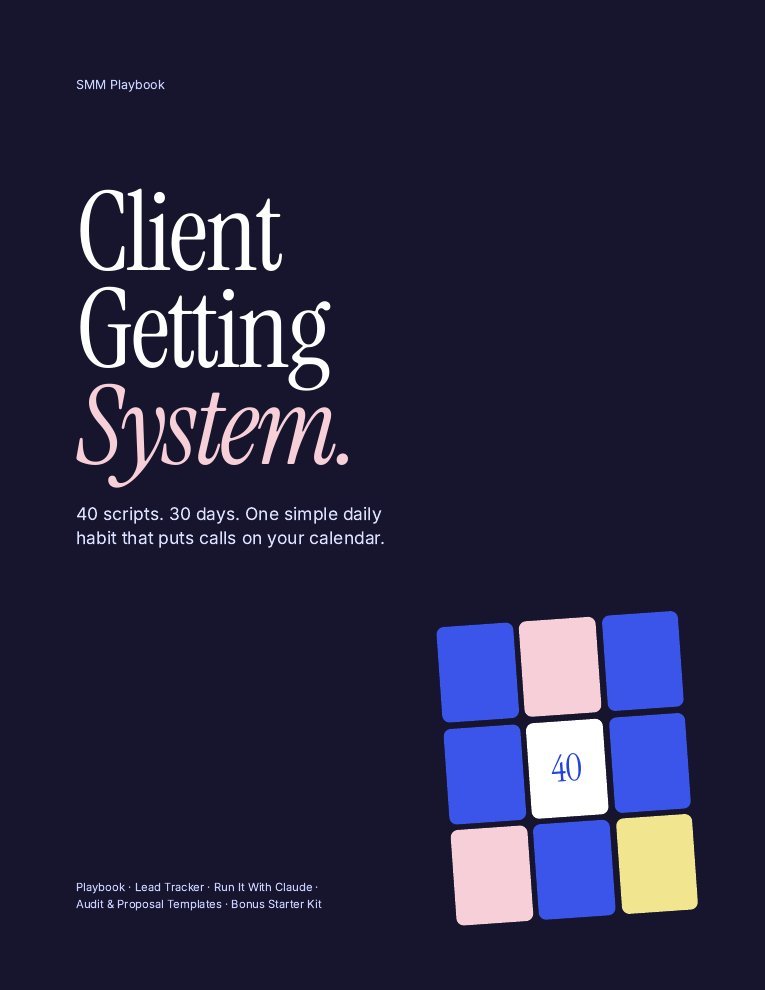
The Client Getting System is the freelance route, done for you: the 7-day launch roadmap, 40 outreach scripts, the lead tracker, audit and proposal templates and the contract.
- 40 copy-and-paste scripts (DM, email, walk-in, follow-ups, replies)
- Lead tracker that scores every business for you
- Free audit + proposal templates, call script
- Contract, onboarding form and pricing workbook
- Run It With Claude guide (Claude finds the leads)
One payment · Instant download · Works with free Claude
Your first 30 days, step by step
| When | What you do |
|---|---|
| Days 1–3 | Learn the basics above. Pick one niche (salons, restaurants, gyms, dentists or real estate) and one town |
| Days 4–7 | Make 9 spec posts, fix your own profile, list 100 local businesses |
| Week 2 | Do quick audits and send 20 personal messages a day |
| Week 3 | Follow up, book 15-minute calls, send proposals |
| Week 4 | Sign your first client with a contract at a fair starter price |
Want every step in detail? Read how to get your first social media client.
Mistakes beginners make
- Buying course after course instead of sending messages.
- Waiting to feel ready. Your first client teaches more than any course.
- Working for free for months “to build a portfolio.”
- Trying every platform. Start with Instagram and Facebook for local businesses.
- Hiding behind posting on your own account instead of reaching out.
FAQ
Can you become a social media manager with no experience?
Yes. As a freelancer, business owners care more about whether you understand their customers than your CV. Honest sample posts, your own account and one discounted first client are enough to start.
Do I need a degree or certificate?
No. Degrees and certificates can help for agency or corporate jobs, but local business clients rarely ask for them. Proof of good work matters more.
How long does it take to become a social media manager?
You can learn the basics in about a week. With daily outreach, many beginners land a first freelance client within about a month, though it varies by niche and effort.
How much do beginner social media managers make?
Freelance beginners often start around $500 to $1,000 a month per client. Surveyed freelancers report higher averages as they gain experience. See our pricing guide for 2026 ranges.
Can I do social media management from home?
Yes. Everything from finding clients to posting and reporting can be done from home with a laptop and a phone.
Will AI replace social media managers?
AI speeds up writing, planning and research, but owners still want a person who understands their business, makes decisions and is accountable for results. Managers who use AI well get more done.
Keep reading
Sources
- EMARKETER on Verizon’s 2025 State of Small Business report (June 2025)
- HeyOrca, Social media pricing report (survey of 100+ agency and freelance social media managers, 2024)
General information, not legal, tax or financial advice. Results depend on your effort and market. See our earnings disclaimer.